When a lift goes wrong, the investigation rarely ends at the crane. It ends at the sling, the shackle, or the signal that arrived a second too late. The slinger/signaller stands closest to all three, which is why the role carries more responsibility than the job title tends to suggest.
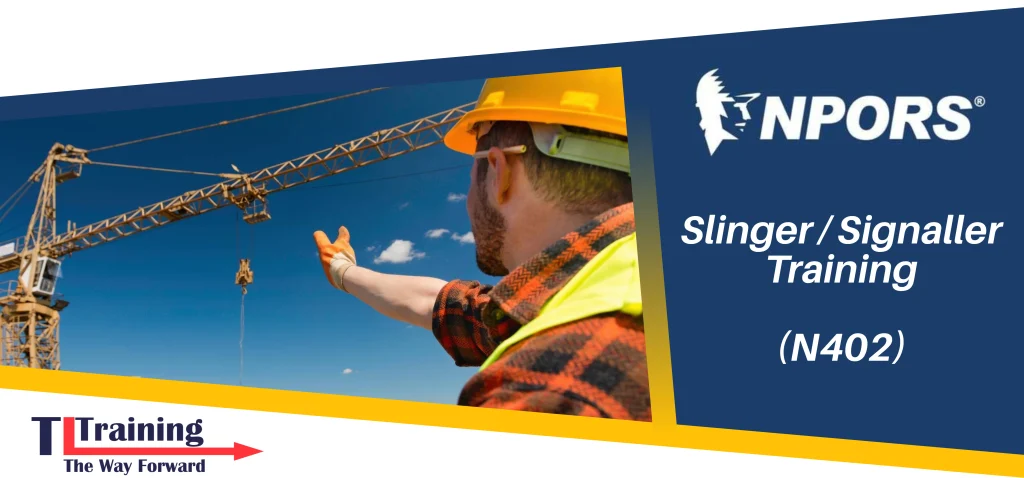
A competent slinger does more than hook up a load and wave the operator in. They assess weight and centre of gravity, select accessories rated for the task, hold the exclusion zone, and keep communication running cleanly between the ground and the cab from first pick to final set down.
TL Training delivers NPORS Slinger/Signaller (N402) training at your premises, anywhere in the UK, using your own crane or lifting appliance and the accessories your team handles week to week. The N402 is recognised across construction, civils, rail, utilities, steel erection, and industrial maintenance.
Why Slinger/Signaller Competence Underpins Every Lifting Operation
Lifting operations fall under LOLER, PUWER, and BS7121, and those standards do not treat the slinger as a junior role in the lifting team. The qualification sits alongside the crane operator and the Appointed Person in a three-part structure where each party depends on the other two doing their job properly.
The slinger is the person choosing whether a two-leg or four-leg sling suits the load, whether the shackle rating covers the shock loading during a swing, and whether the centre of gravity is where the eye says it is or somewhere else entirely. Those judgements shape everything that follows.
Communication adds a second layer. Once the load leaves the ground, the crane operator often loses sight of the landing point, the people on the ground, or the obstacles between the two. The slinger becomes the operator’s vision, delivering hand signals or radio instructions that translate directly into crane movement. A hesitant or ambiguous signal at the wrong moment is how dropped loads and crushing incidents enter the record.
Principal contractors now treat NPORS accreditation as the default benchmark for this role on any site running regular lifts. Informal training rarely holds up under audit, and documented lifting team competence is increasingly asked for at pre-qualification stage rather than during induction.
Training Pathways for Every Level of Slinging Experience
The N402 runs across three routes so that delegates spend time on what they actually need rather than sitting through content they already have covered.
Full Training for New Slingers (2 to 3 Days)
Delegates with no prior lifting experience work through the complete syllabus over two to three days. Early sessions cover lifting theory, accessory types, and the legal framework behind every lift, before training moves into practical rigging, signal protocols, and supervised lifts across progressively more demanding loads until the delegate can run a full cycle without prompting.
Experienced Operator Route (1 to 2 Days)
Workers who have been slinging on site for years without a formal ticket follow a shorter pathway of one to two days. Time is spent aligning existing technique with NPORS and BS7121 expectations, tightening signalling discipline, and preparing for assessment. Evidence of prior involvement in lifting operations is required, usually through an employer reference or site training record.
Refresher Training for Existing Cardholders (1 Day)
A single-day refresher suits current or recently expired N402 cardholders renewing for the next five-year cycle. The session revisits core theory, updates delegates on any changes to guidance since the previous certification, and closes with reassessment. Teams running rolling certification across multiple operators often schedule N402 refreshers alongside adjacent tickets to keep downtime contained.
What the NPORS N402 Syllabus Covers
Because training happens on your site and with your kit, the practical element uses the specific cranes, slings, shackles, and spreader beams your slingers actually handle. Rigging choices are rarely interchangeable, and a delegate who trained on nylon round slings and then has to work with chain slings or a custom lifting frame is starting again on the parts that matter most. On-site NPORS delivery closes that gap before it has a chance to open.
By assessment, delegates can estimate load weight and identify the centre of gravity, inspect lifting accessories for defects, rig loads using the correct configuration for the shape and weight involved, direct crane movement through approved hand and radio signals, and hold an exclusion zone against the pressure that always builds when work runs behind schedule.
Core syllabus areas include:
- Legislation under HASAWA, LOLER, PUWER, and BS7121
- Roles and responsibilities within the lifting team
- Lifting accessories (slings, shackles, hooks, spreader beams, lifting clamps) and their safe working loads
- Pre-use inspection and defect reporting for lifting gear
- Load weight estimation, centre of gravity, and balance principles
- Hand signal protocols and radio communication discipline
- Exclusion zone management and positioning for visibility
- Controlling and guiding loads through every stage of the lift
The N402 also functions as a natural entry point into our wider NPORS course portfolio, with many slingers progressing onto Crane/Lift Supervisor (N405) or Appointed Person (N401) as they move into supervisory roles.
Book Slinger/Signaller Training at Your Premises
Setting up on-site delivery is straightforward. You need to provide a crane or lifting appliance in safe working order, a selection of lifting accessories representative of your day-to-day work, stable ground with space for a controlled lift area and exclusion zones, and a room or sheltered space for the theory sessions. The instructor arrives with everything else.
Nationwide bookings are available, and we work regularly with clients running recognised slinger/signaller training programmes for construction, utilities, and industrial sites. To discuss pricing, mixed-experience group sizes, or forward planning around card expiries, call 0151 343 0588 or email [email protected] for a same-day response during business hours.