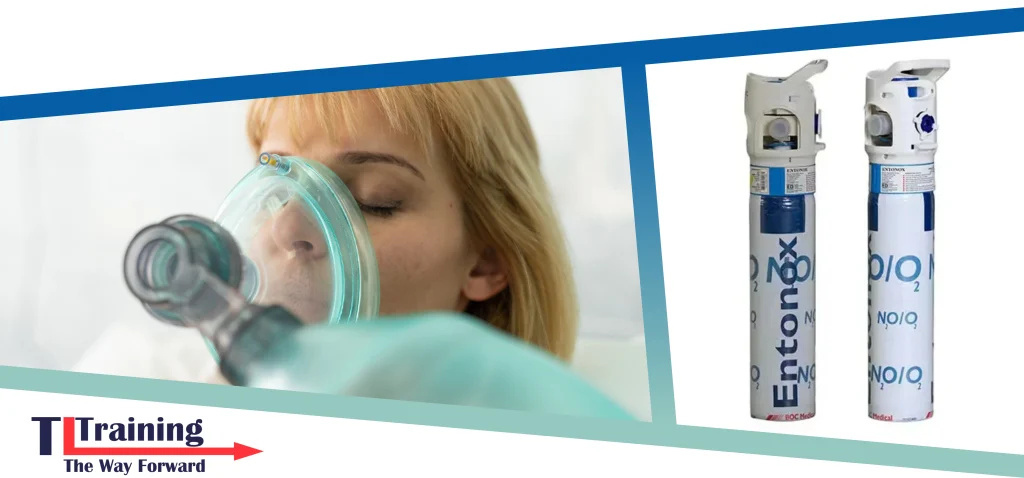
Emergency medical gases training gives responders the competence to safely store, handle, and administer oxygen and Entonox in pre-hospital and emergency care settings. It is a regulated, hands-on qualification that sits at the more clinical end of first aid training, and it is increasingly expected of anyone working in event medical cover, remote operations, or alongside ambulance and healthcare teams.
At TL Training, we deliver the Qualsafe Level 3 Award in Administering Emergency Medical Gases as a one-day course at our Ellesmere Port training centre, with on-site delivery also available for teams across the UK. It is a qualification that carries real weight in pre-hospital care environments, and for good reason.
What Emergency Medical Gases Training Is
The Level 3 Award in Administering Emergency Medical Gases is a regulated qualification awarded by Qualsafe Awards and sitting on the Regulated Qualifications Framework (RQF). It teaches learners how to safely use two medical gases commonly relied on in emergency settings, oxygen and Entonox (a nitrous oxide and oxygen mix used for pain relief), and it is designed specifically for responders who may need to deliver gas therapy before a patient reaches definitive care.
The course runs for one day, combining theory with practical work on real cylinders, regulators, masks, and demand valves. Learners are assessed on both the knowledge side, covering indications, contraindications, and safe handling, and the practical side, including cylinder checks, patient preparation, and administration under observation. On successful completion, learners receive a nationally recognised Ofqual-regulated qualification that employers in pre-hospital care environments widely trust.
It is not a standalone first aid qualification in the way that First Aid at Work is. It sits on top of existing competence, which is why it is so often taken alongside or after FREC 3.
Why Emergency Medical Gases Training Matters
Oxygen and Entonox are genuinely useful clinical tools in the right hands, but they carry real risk when handled incorrectly. Cylinders are pressurised, gases interact with medications and medical conditions in ways that need to be understood rather than guessed at, and the equipment itself (masks, demand valves, flow meters) requires setting up and testing properly before it touches a patient. Getting any of this wrong can turn a treatment into a new problem.
This is why the training exists as a dedicated qualification rather than being absorbed into general first aid courses. A responder who can correctly identify when oxygen therapy is appropriate, set flow rates accurately, monitor a patient’s saturation during administration, and document everything afterwards is operating at a level above standard first aid. The qualification gives employers a clear, verifiable way of knowing their people can do that safely.
For context on where this sits relative to broader training, our first aid and medical training overview covers the full pathway. Emergency medical gases training is a meaningful step up from general workplace first aid, and it is usually combined with a pre-hospital care qualification rather than taken on its own.
Who Benefits Most From This Training?
The course is aimed squarely at people who may realistically need to administer oxygen or Entonox in a pre-hospital or emergency environment, and the roles where it lands most usefully are relatively specific.
First Responders and Ambulance Support Staff
For anyone in a community first responder, ambulance support, or pre-hospital care role, emergency medical gases training is often a core competency rather than an optional extra. It complements the clinical assessment skills developed on pre-hospital care qualifications by adding a practical treatment modality that can genuinely change patient outcomes while waiting for definitive care.
Event Medics and Remote Site Responders
Event medics working festivals, sports venues, or motorsport, along with responders covering remote industrial sites or offshore environments, are another natural fit. In these settings, definitive medical care can be some distance away, and the ability to administer oxygen or manage pain with Entonox while transport is arranged is genuinely valuable.
Fire, Security, and Specialist Operational Teams
Fire service personnel, security teams at larger venues, and specialist operational roles in energy and utilities often hold this qualification as part of a broader medical response capability. It sits well alongside trauma-focused training where the ability to support breathing and manage pain is part of managing the patient until paramedics arrive.
Learners Progressing From FREC 3
For anyone who has completed FREC 3 and is building toward a more advanced pre-hospital care role, emergency medical gases training is a natural next step. It also complements FREC 4 for those pursuing the advanced pathway, where confident handling of oxygen and Entonox is expected rather than optional.
What Emergency Medical Gases Training Course Covers
The day is structured around both the knowledge learners need and the practical skills they will be assessed on. Content covered includes:
- Roles, responsibilities, and legal requirements when administering medical gases, including scope of practice and documentation.
- Properties, indications, contraindications, and side effects of oxygen and Entonox.
- Safe storage, handling, and transportation of cylinders, including checking pressures, expiry dates, and labelling.
- Use of delivery systems and equipment, covering masks, demand valves, tubing, flow rates, and setting up and testing equipment before use.
- Administering oxygen and Entonox to patients safely and effectively, preparing the patient and environment beforehand.
- Monitoring patient response and oxygen saturation during administration, plus completing post-use checks and documentation.
- Practical scenario-based assessment using simulated emergency situations, with coached feedback on technique.
Delivery is led by experienced instructors with genuine pre-hospital experience, and all training equipment is provided. Learners leave with a clear understanding of where their scope of practice begins and ends, which is critical in any role involving clinical intervention.
Location and Delivery Options
Most of our emergency medical gases training is delivered at our Ellesmere Port training centre at The Technology Centre, just off Junction 9 of the M53. The venue is modern, accessible, has free on-site parking, and is well placed for delegates travelling from Liverpool, the Wirral, Chester, and across the wider North West.
For organisations looking to train teams together, on-site delivery is available anywhere in the UK, with the course schedule and equipment tailored to your setting. This tends to make sense for ambulance providers, event medical companies, and operational teams wanting to train a whole cohort to a consistent standard.
Book Emergency Medical Gases Training Today
If you are weighing up emergency medical gases training for yourself or your team, the easiest next step is a short conversation about what you need. Open course places at Ellesmere Port can be booked directly through the course page, and our team can talk you through on-site delivery, group pricing, and how this qualification fits alongside FREC 3, FREC 4, or other pre-hospital care training.
We’re available on 0151 343 0588 or via email at [email protected].