
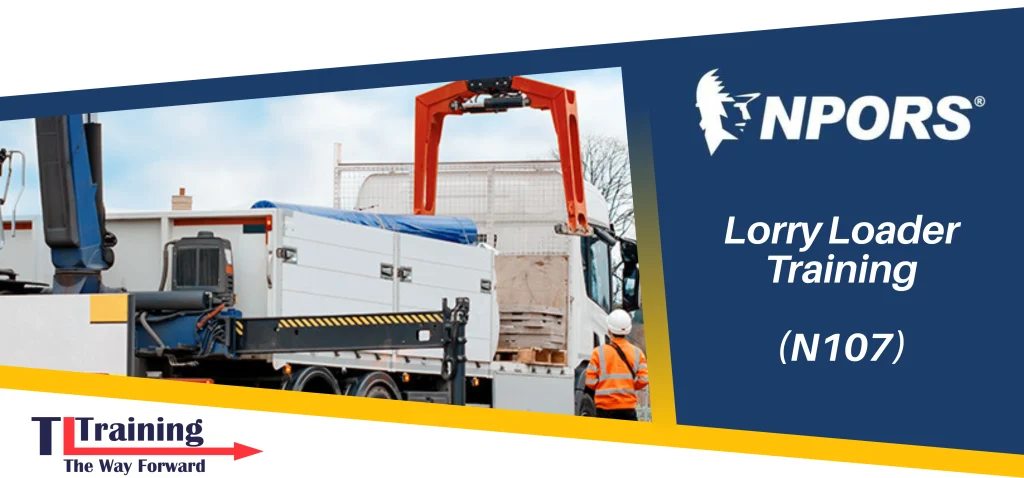
Lorry loaders sit in a category of their own. Unlike most lifting equipment, the crane and the delivery vehicle arrive together, meaning your operator is responsible for everything from the moment they leave the yard to the moment the load reaches its final position.
That might be a builders’ merchant kerbside in a busy high street, a scaffolding drop on a residential road, or a precast delivery onto an active construction site. Each scenario brings its own mix of traffic, pedestrians, overhead services, and variable ground, and none of it waits for the operator to catch up.
TL Training delivers NPORS Lorry Loader (N107) training at your premises, anywhere in the UK. Your drivers train on your own HIAB, using the lifting accessories they already work with and the load types they handle week in, week out.
When they pass assessment, they leave with the NPORS N107 card, recognised across construction, logistics, transport, waste, and distribution sectors.
The Compliance Picture for Lorry Loader Operations
Few pieces of lifting equipment operate in as many different environments as a lorry loader. One day the job might involve a straightforward yard-to-yard delivery; the next could mean setting up outriggers on a pavement with pedestrians walking past and an 11kV cable running overhead.
That variability is precisely why the regulatory framework matters, and why informal experience rarely gives operators everything they need to handle whatever the next drop throws at them.
Lorry loader operations fall under LOLER, PUWER, and BS7121 requirements, with BS7121 Part 4 dealing specifically with lorry-mounted cranes. Meeting those standards is not a box-ticking exercise. It shapes how lifts should be planned, how accessories should be selected and inspected, and how the operator communicates with anyone assisting on the ground.
When something goes wrong – a dropped load on a domestic driveway, a near-miss with a power line, a stability failure on a sloping kerb – investigators work backwards through the operator’s training record. An NPORS card demonstrates that your driver has been assessed against industry standards, sits on a verifiable national database, and provides the documented competence your clients, your insurers, and the HSE all expect to see.
How the Lorry Loader Training Adapts to Your Team’s Experience Levels
Not everyone booked onto an N107 course arrives at the same starting point, so forcing a fixed duration on every delegate would waste both time and budget. Training therefore splits into three pathways, each calibrated to the experience your team already brings to the job.
Complete Training for New Operators
Delegates with no prior lorry loader experience complete a two to three day programme that builds competence from the ground up. The earliest sessions cover the HIAB itself – controls, stabiliser deployment, load charts, and the pre-use checks that catch problems before they travel out of the yard.
From there, training progresses through rigging, lifting, load control during transit, and the de-rigging and stowing routines that close out every job safely. By the time the assessment begins, novices understand not just how to make the crane move, but why certain setup choices matter more than others.
Focused Certification for Experienced Operators
Plenty of drivers have been using HIABs for years without ever holding a formal qualification, and a one to two day programme is designed specifically for them. Rather than retreading familiar ground, instructors focus on bringing existing technique into line with current NPORS training standards, filling any gaps in theoretical knowledge, and preparing delegates for theory and practical assessment.
The pathway respects the experience your drivers already have while confirming it on paper – which is often the piece clients and compliance teams actually need.
Refresher Training for Current Cardholders
Existing N107 cardholders approaching the five-year renewal point complete a single-day refresher. The instructor reviews any changes to regulations or operational guidance since the previous certification, observes continued practical competence, and runs the reassessment that issues a fresh card.
Booking the refresher before the current card expires keeps your operator working without a gap and avoids the longer programme that becomes necessary once certification has lapsed significantly.
What the Lorry Loader Training Covers
Classroom instruction and practical operation run in parallel throughout the course. Because training takes place on your equipment and at your premises, the scenarios delegates work through mirror the real lifts they will perform once certified – right down to the specific load types, accessories, and ground conditions they encounter routinely.
By assessment, operators can set up a lorry loader safely on variable ground, interpret load charts and work confidently within rated capacities, select and inspect lifting accessories, and control loads through every stage of a lift. Written testing runs alongside observed practical operation, producing a card that reflects genuine capability rather than just familiarity with the machine.
Core syllabus areas include:
- Legislation covering HASAWA, PUWER, LOLER, and BS7121 Part 4
- Pre-use inspections, routine checks, and defect reporting
- Stabiliser deployment, ground assessment, and exclusion zones
- Lifting accessories – slings, hooks, chains, clamps – and their inspection
- Load planning, communication protocols, and working with a slinger/signaller
- De-rigging, stowing, and post-operation procedures
Book NPORS Lorry Loader Training at Your Site
Because training takes place at your premises, arranging it is largely a matter of agreeing dates and confirming a few practical details.
Your side of the arrangement is straightforward: a lorry loader in sound working order, valid inspection records, suitable lifting accessories, representative loads to practise on, and stable ground with enough space for outrigger deployment and manoeuvring. A room for the theory sessions rounds out what the site needs to provide. Everything else (registration with NPORS, course materials, assessment, and certification) falls on our side.
To discuss dates, delegate numbers, or anything site-specific, call us on 0151 343 0588 or email us at [email protected]. Enquiries made during business hours receive a same-day response, and we are happy to walk through site suitability before anything is booked.
You can also get in touch through our contact page, explore the full range of NPORS courses we deliver, or read more about how our on-site training model works for teams with ongoing certification needs.