
Being struck by a moving vehicle or piece of plant remains one of the leading causes of fatal injury on UK construction sites, and the HSE’s own analysis keeps returning to the same contributing factor. Someone was in a place they should not have been, or the operator could not see them, or the communication between the two broke down somewhere in between.
The machine itself is rarely the problem. The interface between plant, pedestrians, and other vehicles is where things go wrong, and that interface is exactly what a plant machinery marshal is trained to manage.
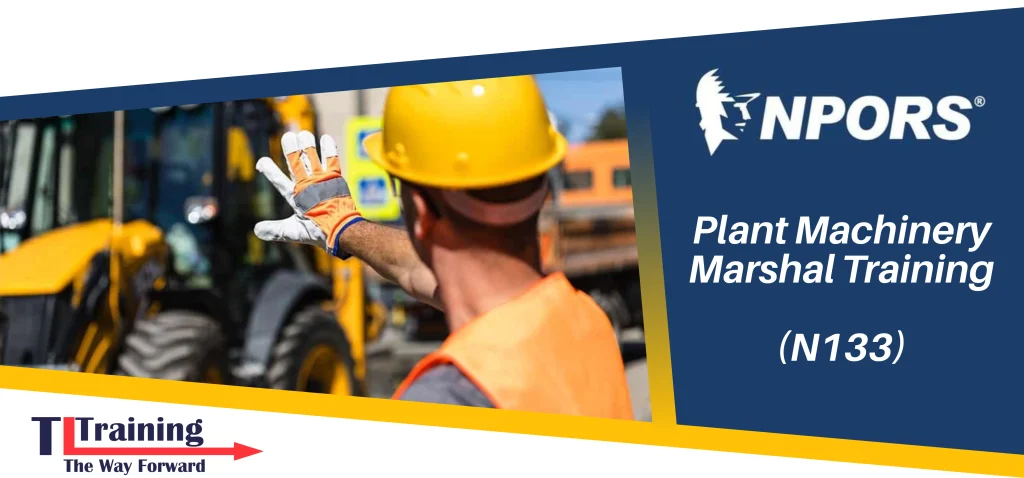
TL Training delivers NPORS Plant Machinery Marshal (N133) training at your premises, anywhere in the UK. Delegates train in the environment they will be marshalling in, using the plant they will actually be directing, which matters more in this qualification than in almost any other operator-level ticket. A marshal learning on an empty test yard is not the same as a marshal who has spent their practical day working real sightlines, real blind spots, and real pinch points.
Successful candidates leave with the NPORS N133 card, recognised across construction, civil engineering, utilities, waste management, and logistics sectors.
Why Plant Marshalling Is Its Own Discipline
Most plant tickets certify what someone does when they are in the cab. The N133 certifies what someone does when they are outside it, often several metres away, with responsibility for keeping everyone around a moving machine safe.
The work combines safety-critical decision-making with a specific technical skillset around signalling, sightlines, and traffic control, and it carries real legal weight under HSG144 (the HSE guidance on workplace transport) alongside general duties under HASAWA and PUWER.
The job description looks simple from the outside. Stand in the right place. Give the right signals. Keep people out of the way. In practice, the marshal is the person holding the reverse manoeuvre together, protecting a groundworker who cannot see the telehandler behind them, keeping a delivery driver clear of a swinging excavator counterweight, and making split-second calls when a pedestrian walks into an exclusion zone that was perfectly clear thirty seconds ago.
Site managers increasingly recognise this as one of the most consequential roles in their NPORS-accredited workforce, which is why formal certification has moved from nice-to-have to mandatory on most principal contractor sites.
Training Pathways Based on Experience
The N133 runs as a one-day course across all three experience levels, with the structure adjusted to match what delegates bring into the room. Course length stays consistent because marshalling cannot be meaningfully rushed or stretched beyond a day, but the emphasis shifts depending on background.
One-Day Training for New Marshals
Delegates new to marshalling spend the day working through the full syllabus, with theory and practical elements balanced across the session. Time goes into standard hand signals, radio protocol, sightline awareness, and setting up exclusion zones under supervision. Practical exercises pair delegates with live plant on site, so by the end of the day they have directed real machine movements under assessment conditions rather than classroom simulations.
This approach reflects the reality that our plant training delegates encounter in live environments, not controlled demonstrations.
Focused Certification for Experienced Marshals
Delegates who have been banking and marshalling without formal certification follow the same one-day structure, but the balance tilts toward aligning existing habits with NPORS and HSG144 expectations. The theory component addresses where site practice may have drifted from the standard. The practical focuses on tightening signalling discipline and preparing for assessment.
Experienced delegates are usually stronger on instinct and positioning, and weaker on standardised communication, which is where the day tends to concentrate.
Refresher Training for Current Cardholders
A one-day refresher suits current or recently expired N133 cardholders (within six months of expiry). The session reviews changes to HSE guidance or site practice since the last certification, revisits core signalling and positioning principles, and concludes with reassessment.
What Plant Machinery Marshal Training Covers
Because delivery happens on your site, the practical element uses the specific machines, sightlines, and manoeuvring areas your marshals will actually work. This matters because a marshal trained against a generic yard layout still has to learn your layout on day one after certification. Training in the real environment removes that gap entirely.
By assessment, delegates can direct plant and vehicles using approved hand and radio signals, identify and control hazards during machine movement, position themselves to remain visible to operators at all times, manage blind spots and restricted visibility, establish and maintain exclusion zones, and carry out emergency stop procedures when a situation deteriorates. This is the same standard of operator support expected across our NPORS course portfolio, including tickets like Slinger/Signaller (N402) and Vehicle Marshal (N403) that share technical ground with the N133.
Core syllabus areas include:
- Legislation under HASAWA, PUWER, HSG144, and NPORS guidance
- Roles and responsibilities of marshals, operators, and supervisors
- Hand and radio signal protocols to NPORS standards
- Sightline management, blind spot awareness, and positioning
- Exclusion zone setup and pedestrian segregation
- Pre-task planning, communication checks, and handover
Book or Register Interest in Plant Machinery Marshal Training Today
Arranging on-site delivery is straightforward. You provide a suitable operational area with safe visibility, at least one piece of plant or a vehicle for practical exercises, communication equipment if radios are used on your site, and a room for the theory element. Our instructors bring everything else, including course materials, NPORS registration, assessment, and card issue.
If you want pricing and dates without a full booking commitment yet, the quickest route is to register interest directly on the course page, which sends your details through to our team for same-day response during business hours. We are also happy to walk through site suitability beforehand for teams managing wider operator certification programmes or scheduling multiple delegates across different ticket categories.
Call 0151 343 0588 or email us to discuss requirements, including combined bookings alongside related plant and lifting qualifications where site traffic and pedestrian control overlap with other operational roles.