
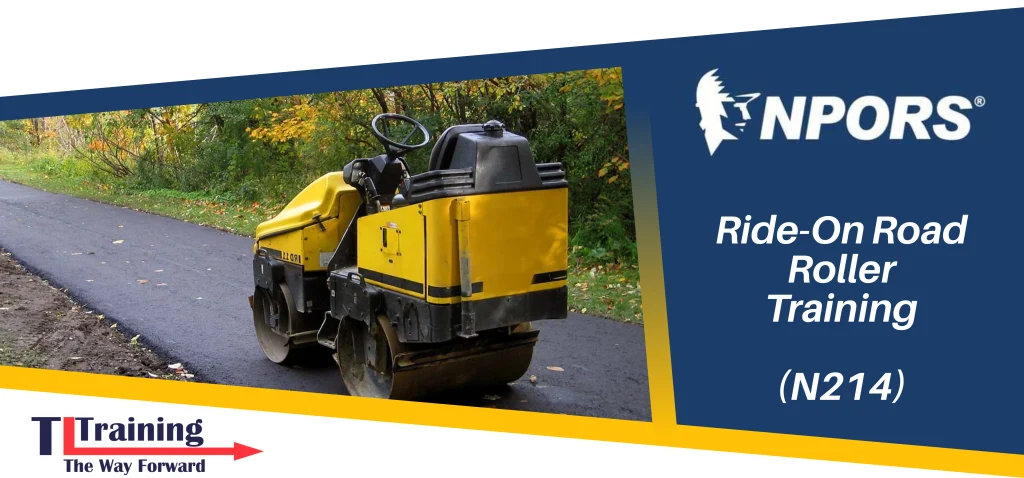
The ride-on roller is often the most under-estimated machine on site. It moves slowly, the controls look basic, and from a distance the job looks like driving in neat overlapping lines. What this impression misses is that the roller is the machine responsible for whether every layer underneath finished ground holds up or fails, and that the machine itself behaves very differently from how it appears.
A high centre of gravity, significant mass concentrated in the drums, and a tendency to drift on soft or cambered ground all make the roller one of the more demanding pieces of plant to run well on embankments, trench reinstatements, and layered sub-bases.
TL Training delivers NPORS Ride-On Road Roller (N214) at your site, using your own machine and working area. Unlike the support-level plant tickets, N214 is a primary operator qualification, which means the assessment expects genuine machine competence rather than awareness or observation. Successful candidates receive the NPORS N214 Ride-On Roller card, recognised across highways, civil engineering, housebuilding, rail infrastructure, and utility reinstatement work.
Why Roller Operation Is a Technical Discipline
Compaction is engineering, not just rolling. Every material responds differently to passes, amplitude, and frequency.
Clay compacts through kneading and responds to padfoot or sheepsfoot drums. Granular materials need vibration to expel air between particles. Hot-rolled asphalt has a workable temperature window of a few minutes, and once it drops below spec the mat will never reach the required density regardless of how many additional passes the operator makes. Too few passes and the layer fails in service. Too many, or the wrong vibration setting, and the operator over-compacts aggregate or damages freshly laid asphalt.
The machine-handling side is equally specific. Rollers do not behave like excavators or dumpers on gradients, edges, or soft shoulders, and the combination of momentum and limited steering authority means corrective action has to happen earlier than on most plant.
Our broader plant operator training portfolio includes machines with more obvious risk profiles, but the roller consistently demands the most attention to ground conditions and gradient awareness on a working site.
Ride-On Road Roller Course Durations and Structure
The N214 runs across three pathways, with duration matched to experience. The course blends theory on compaction principles, legislation, and machine controls with practical work on your own roller, using representative material wherever the site allows.
Novice Training (2–3 Days)
Suitable for delegates with no previous roller experience. Time is spent building from machine familiarisation through controls and pre-use inspection to supervised compaction on flat ground, then progressing to cambers, gradients, edge work, and managing different materials.
Theory elements cover legislation under HASAWA and PUWER, compaction methods for soil, aggregate, and asphalt, and the defect reporting process that keeps the machine maintained. Delegates finish the programme ready to sit the full NPORS theory and practical assessment.
Experienced Training (1–2 Days)
Aimed at operators with prior roller experience but no formal certification, often groundworkers or multi-ticketed site operatives who have been running rollers as part of wider duties. The session concentrates on aligning existing technique with the NPORS standard, tightening pre-use check discipline, and preparing for assessment. Evidence of previous operation is required, typically an employer reference or a site training record.
Teams running rolling certification programmes for plant and groundworks operators often group experienced candidates into combined delivery days to keep disruption to a minimum.
Refresher Training (1 Day)
For current or recently expired N214 cardholders who need to renew. The day recaps changes to guidance, revisits compaction principles and machine-handling fundamentals, and concludes with reassessment.
Booking ahead of the expiry date keeps the operator continuously certified, and we support clients managing NPORS renewals across multiple operators by scheduling refreshers as a rolling programme rather than leaving them to the last minute.
What the N214 Course Covers
Because delivery happens on your own machine and in your own working area, delegates work with the specific roller configuration they will operate after certification, whether that is a single-drum vibratory machine, a tandem drum asphalt roller, or a combination unit.
This matters because vibration controls, amplitude settings, and water spray systems vary between manufacturers, and walking into an unfamiliar cab after a generic training course creates its own risk.
Core syllabus areas include:
- Legislation and standards under HASAWA, PUWER, and NPORS operational guidance
- Roller types and their applications including static, vibratory, and combination machines
- Pre-use inspection, daily checks, and defect reporting
- Water spray systems and their role in asphalt work
- Machine controls, vibration settings, and amplitude selection
- Compaction passes for different material types
- Working on gradients, cambers, and alongside edges or embankments
- Managing exclusion zones and ground workers in proximity
- Safe parking, isolation, and end-of-shift procedures
- Theory and practical assessment to NPORS criteria
This is the same standard of delivery we apply across the wider NPORS training range, with assessment structured to hold up to audit scrutiny from principal contractors and client compliance teams.
Book or Register Interest in Ride-On Road Roller Training
Arranging on-site delivery is straightforward. You provide a ride-on roller in safe working order with maintenance records available, suitable material to compact (soil, aggregate, or asphalt depending on your work), stable ground for practice, space for exclusion zones, and a room for the theory element. Our instructors bring course materials, NPORS registration, assessment, and card issue.
If you want pricing and availability without committing to a full booking, the fastest route is to register interest directly on the course page. Your details come through to our team and we respond the same day during business hours with tailored pricing based on delegate numbers and experience mix. We are also happy to discuss combining N214 with related plant tickets such as Forward Tipping Dumper (N204) where multi-ticketed operators need to cover adjacent elements of the same groundworks package.
Call us on 0151 343 0588 to discuss requirements, mixed-experience group bookings, or forward planning for renewals across a larger workforce.