

Almost everything written about IOSH training assumes there is an employer somewhere in the background, holding the budget and deciding who goes on which course. Plenty of people arrive at it from completely the other direction, having seen the qualification listed on job adverts they want to apply for, or having been told by a client that they need something formal on file, or having worked out that the step up into a supervisory role is not going to happen without it.
If that is your position, the questions you need answered are not the ones an HR manager is asking. You are not weighing up cohort sizes or whether to bring a trainer to site. You want to know whether the certificate carries real weight with the people who will read your CV, which of the courses to book when there is nobody above you making that call, and what you are walking into on the day.
The reassuring part is that the range is short and the decision is more clear-cut than it looks from outside, so once you can see how the IOSH courses map onto the work you do or want to do, choosing takes about five minutes. Most of the confusion comes from picking a course before you have been honest about the level you are actually working at, which is the same trap employers fall into when they are deciding what to put their teams through.
Why People Book IOSH Training Without an Employer Behind Them
The routes into self-funded IOSH training are more varied than you might expect. Some people are between jobs and want something on the CV that survives a change of sector, since the qualification travels across construction, warehousing, manufacturing, healthcare, retail and office environments without needing to be re-explained each time.
Others are contractors or sole traders who keep being asked what safety training they hold whenever they price up work for a larger client. A fair number are already doing a supervisor’s job in everything but title, and want the certificate that makes the promotion conversation easier to open.
What connects those situations is that you are buying two things at once. There is the knowledge, which genuinely matters if you spend your working day around moving vehicles, machinery, height or hazardous substances, and then there is the signal the certificate sends to somebody who has never met you and has forty applications to get through.
Because IOSH is an independent chartered body rather than a company selling its own branded courses, that signal is understood without you having to explain it, which is much the same reason employers keep coming back to it when they are hiring, tendering or being audited.
Choosing Between the IOSH Training Courses With Nobody to Steer You
There are three courses to pick from and they sit at clearly different levels rather than overlapping, so the honest way to choose is to be truthful about the responsibility you hold now, or the responsibility you are trying to move into.
The gap between Working Safely and Managing Safely comes down to whether you are accountable for your own safety or for other people’s. Reaching for the longest course on the assumption that more days means more value is the most common mistake individual bookers make.
If You Work On Site, On the Floor, or On the Tools
IOSH Working Safely is the one-day option, running to roughly seven hours, and it assumes no prior health and safety knowledge whatsoever. You cover spotting hazards, the basics of assessing risk, what the law expects of you personally, and what to do when something goes wrong in front of you.
There is no exam at the end, with assessment happening across the day based on how you engage with the activities, and you keep a workbook you can go back to afterwards. For most operative, driver, warehouse and general site roles, this is the certificate the advert is asking about.
If You Supervise People, or Are About To
IOSH Managing Safely runs over three consecutive days, totals around 21 hours, and is built for anyone carrying responsibility for how other people work. The content moves well past awareness into risk assessment proper, your legal duties as somebody in charge, investigating incidents, and measuring whether safety performance is genuinely improving rather than just feeling better.
You complete assessed activities and a practical risk assessment project drawn from a real workplace, which is worth thinking about ahead of time if you are booking under your own steam and do not have an obvious site to write about. Employers read the certificate as a marker of somebody who can manage risk deliberately rather than react to it.
If You Already Hold Managing Safely and It Has Aged
IOSH recommends topping the qualification up every three years, and the Managing Safely Refresher is the one-day route to doing that without sitting the full three days again. It brings you back in line with current legislation and practice. If you are job hunting with a certificate dated five or six years ago, the refresher is a cheap way to stop that date being something you have to explain.
Getting More Out of the IOSH Training Days Than a Certificate
Turning up with something specific in mind changes what you take away, and that matters more when the money is yours. Spend half an hour beforehand thinking about what has gone wrong, or nearly gone wrong, in workplaces you have actually been in, because those examples are what give the group discussions and the risk assessment work something to bite on.
Delegates who arrive with real material get noticeably more from the room than those improvising on the day, so a bit of thinking done before the course starts pays for itself several times over.
A few things worth doing:
- Note down two or three real hazards from your own working life to use in the exercises
- Decide in advance what you want to be able to do differently afterwards
- Pick a week where you are not also covering somebody else’s shift
- Keep the workbook, because it is the part people still reach for months later
Once you are back at work, the certificate is the smallest part of what you are holding. The people who get lasting value from it are the ones who put one thing into practice inside the first month, whether that is rewriting a risk assessment so it reflects how the job is really done or changing how controls get communicated at handover, and that is what turns three days in a classroom into capability that holds up under pressure.
If you are already the person others look to when something looks unsafe, that habit is what gets you noticed.
Booking Your IOSH Training With TL Training
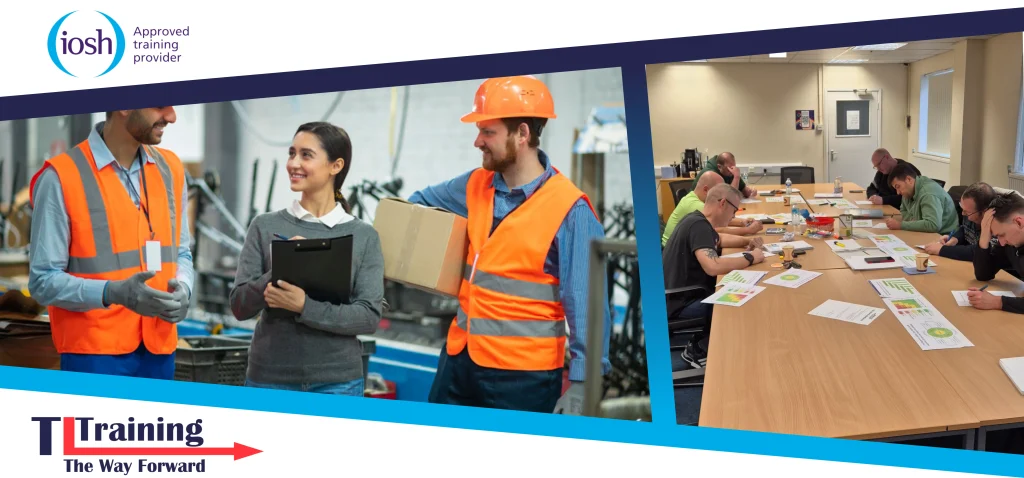
As an approved provider, we run Working Safely, Managing Safely and the Managing Safely Refresher on scheduled dates from our Ellesmere Port centre, just off Junction 8 of the M53.
Open course places are exactly what individual bookings are for, so you will be in a mixed group alongside people from other sectors, and sessions are capped at twelve delegates so there is room to ask the questions that matter to your own situation.
Current dates and pricing sit on each course page, and you can register your interest with us if nothing showing lines up with your availability. If it turns out you are asking on behalf of a team rather than yourself, the questions shift towards sequencing, group size, and timing across a workforce, and the answers change with them.
To talk through which course fits where you are now, call us on 0151 343 0588 or get in touch with the team and we will point you in the right direction.